
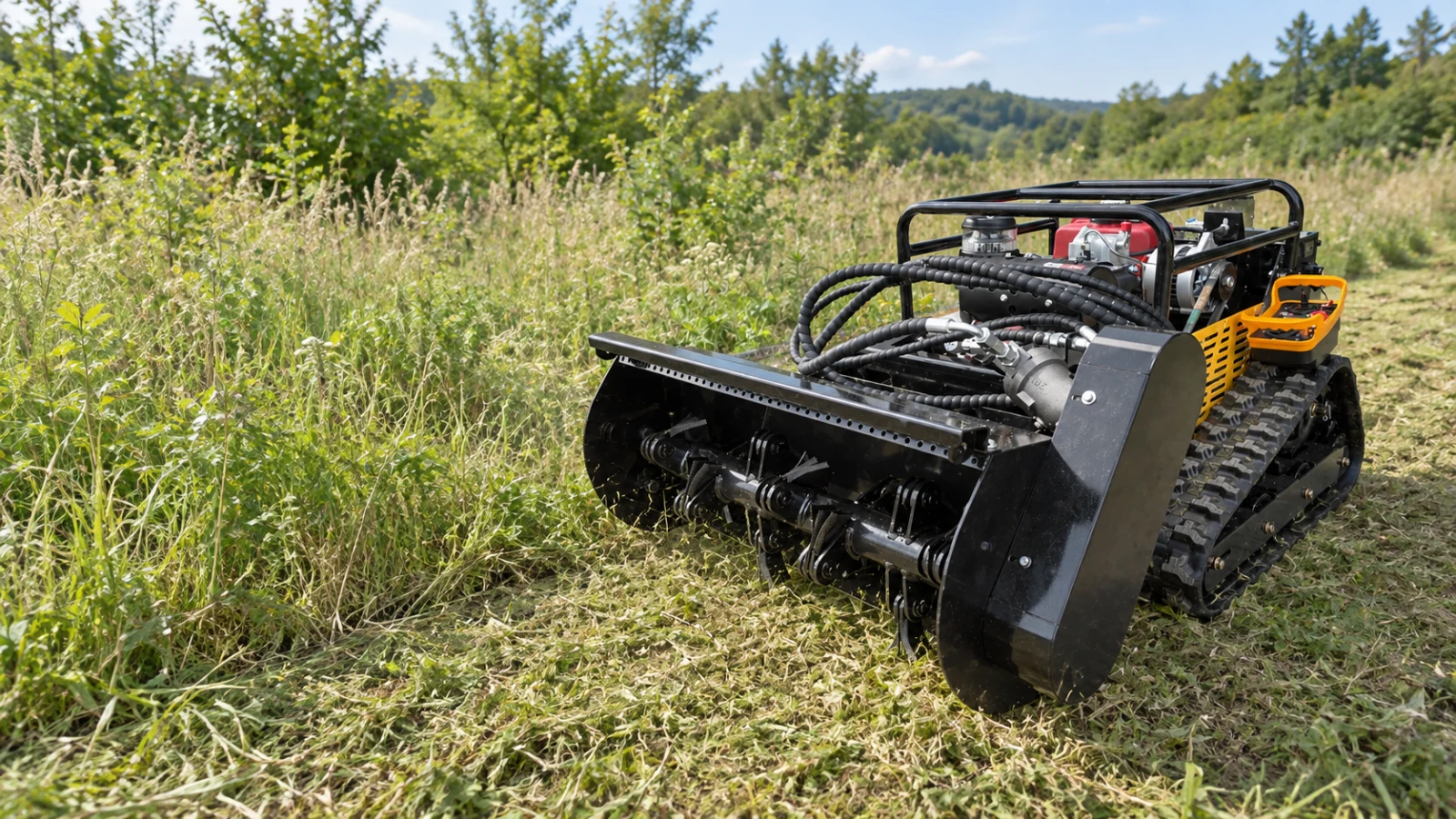
Rotary blades are for regular grass. Flails are for tougher vegetation.
Quick Answer For ordinary grass maintenance, a rotary blade mower is usually the simpler and more economical choice. For thick weeds, small branches, shrubs and brush, a flail drum is usually the safer starting point. Y flails and hammer flails can both cut tougher vegetation within the machine's rated capacity, but hammer flails are heavier and can shred dense material more aggressively. That extra impact also asks more from the engine and drive system.
Choose by vegetation, not by the blade name alone
Cutting system comparison Two remote mowers can look similar from the outside but perform very differently under the deck. The cutting system decides how the machine attacks grass, weeds and woody stems. The table below is a practical starting point for quotation discussions. Final selection still depends on cutting width, engine option, rotor design, blade weight and the actual vegetation on site.
Rotary blades suit grass maintenance and cleaner everyday mowing
01 · Rotary blade use A rotary blade system is usually the right discussion when the buyer mainly cuts grass, open lawns, maintained estates, parks or similar vegetation. It can be efficient for routine mowing where the goal is to reduce grass height rather than shred heavy brush.
Y flails and hammer flails both work beyond ordinary grass
02 · Flail options Flail drums are used when the job moves from ordinary grass into thicker and less predictable vegetation. Both Y flails and hammer flails can handle harder material than regular grass, as long as the material is within the machine's rated cutting capacity.
Heavier vegetation needs enough engine power to keep rotor speed
03 · Engine and load Flail mowing depends on rotor speed. When the mower enters dense weeds or woody vegetation, the rotor needs enough power to keep cutting rather than slowing down under load. Hammer flails can help with heavier shredding, but their weight also increases demand on the engine and drive system.
Send vegetation photos before choosing the cutting system
Site photos The most useful photos show the actual material to be cut: grass height, weed density, branch size, woody stems, slopes, wet areas and turning space. A short video is even better because it shows density and stem stiffness more clearly than one still photo.
Need help choosing a cutting system?
Send photos of the grass, branches, brush and working area. VantMech can compare rotary blade, Y flail and hammer flail options for the quoted remote mower.
Frequently asked questions
FAQ No. Y flails can work beyond ordinary grass and are often used for thick weeds, small branches and lighter brush, depending on the mower's rated capacity and site conditions.
Common buyer questions
Are Y flails only for grass?
No. Y flails can work beyond ordinary grass and are often used for thick weeds, small branches and lighter brush, depending on the mower's rated capacity and site conditions.
Are hammer flails always better than Y flails?
No. Hammer flails are heavier and can deliver stronger shredding force, but they also need more power and place more load on the cutting system. For lighter maintenance, Y flails may be more suitable.
Can a rotary blade mower cut brush?
A rotary blade mower is mainly for grass and general vegetation. If the site includes woody stems or dense brush, discuss a flail mower configuration instead of assuming a rotary blade will be suitable.
Which engine should I choose for heavy vegetation?
For demanding flail mowing, VantMech can discuss stronger options such as KOOP 292 diesel or Loncin 608cc and larger engines, but the final choice should match the mower model, rotor and vegetation.
What should I send with an inquiry?
Send site photos or video, vegetation type, grass height, branch or stem size, slope, wet soil areas, access width and the expected finish after mowing.